AI in Substation Design: The Complete 2026 Guide

Updated: Aug 31

If you ask any transmission engineer what causes a substation project to be delayed, the reply usually does not point to the switchgear itself. Instead, it is the design process that is at fault: weeks are wasted sorting out the single-line diagrams, checking the relay settings against the IEC 61850 data models, and rerunning the load-flow studies each time the client alters the transformer rating.
With a global shortage of experienced protection engineers and increasing demand for renewable energy interconnections, the conventional substation design workflow is beginning to break down.
This is exactly where AI in substation design is proving its worth. Instead of replacing engineers, artificial intelligence is being incorporated across the various stages of substation engineering—including design, simulation, and asset management—to shorten timelines, reduce costly rework, and identify errors well before construction starts. For utility companies, EPC contractors, and renewable energy developers operating in the UK, Europe, the Middle East, and India, it has now become a matter of competitive necessity to understand where AI actually provides value and where it does not.
Where AI Is Actually Being Used in Substation Engineering
The term "AI-powered substation" encompasses a wide variety of tools, so it is useful to distinguish between those used during the design stage and those used in operation.
1. Automated Concept and Layout Generation
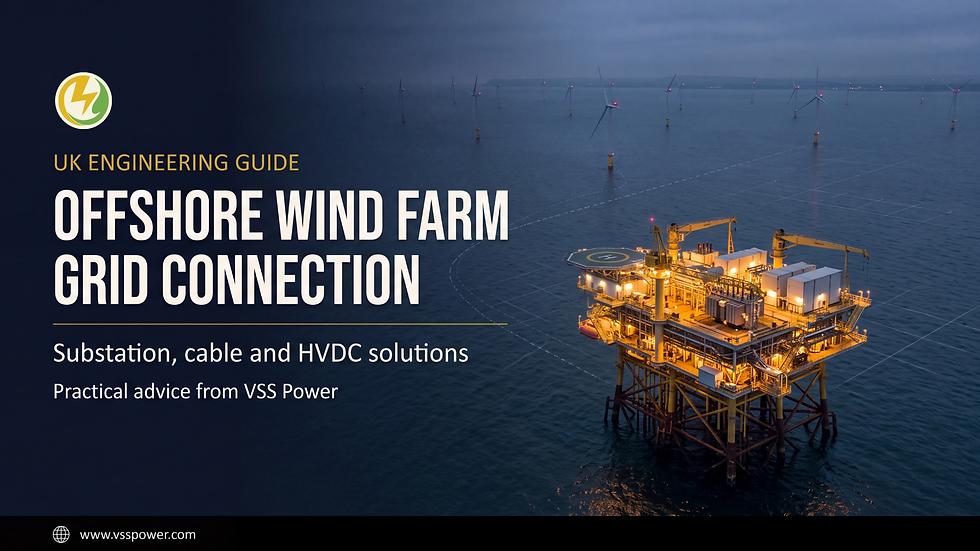
Today's AI applications in substation design software can produce initial 3D layouts of a substation directly based on site constraints, voltage class, and bay configuration requirements. Rather than having an engineer spend a great deal of time drawing dozens of layout versions, generative tools can suggest a number of acceptable arrangements within hours rather than weeks, after which the design team makes the necessary refinements. This is especially beneficial for HV substation design projects with very limited land space, for example, at offshore wind connection sites or in existing urban substations.
2. AI for Electrical Equipment Selection
A highly practical application of AI is in the selection of electrical equipment—this involves matching transformers, circuit breakers, and protection relays to load forecasts, fault-current levels, and environmental conditions. The machine learning models, which have been trained on historical data relating to procurement and failures, are able to identify cases where a particular component is either over-sized (resulting in a waste of capital) or under-sized (leading to a reliability risk), a responsibility that has in the past depended on the individual judgment of engineers and which can differ from one design team to another.
3. Digital Twins and Model-Based Design
Currently, digital twin platforms integrate model-based substation design with AI copilots that have a full understanding of the engineering model—such as the characteristics of every breaker, disconnect switch, and transformer—rather than merely analysing static documents. Since these tools are based on structured data schemas that build on the concepts of IEC 61850's Substation Configuration Language, they enable several engineers to work on the same live model, thereby reducing coordination errors among the civil, electrical, and protection disciplines.

4. Predictive Fault Detection and Asset Health
Although much of this activity occurs after the equipment is commissioned, it still directly influences design decisions. AI models based on artificial neural networks and deep learning analyse the results of dissolved gas analysis, perform thermal imaging, and feed the data back to predict transformer degradation and bushing failures before they occur. Designers are now incorporating this predictive capability into their redundancy planning and spare-parts strategy at the design stage, rather than treating maintenance as a separate issue that comes later.
5. Compliance and Documentation Automation
The preparation of protection coordination studies, bills of materials, and regulatory submission packages take up an unreasonably large amount of engineering time. Nowadays, AI-assisted documentation tools can automatically generate multi-page proposals, drawings, and BIM-ready models that conform to the company's design standards, saving the Power Plant Design and Engineering teams several weeks during the concept-to-permitting process.
Benefits of AI in Substation Design: What the Data Shows
The benefits of AI in substation design go beyond just speed. Utilities testing out these tools are telling us that they are seeing measurable improvements in a number of different areas:
Area | Traditional Approach | AI-Assisted Approach |
Concept design | Weeks of manual iteration | Hours to generate compliant options |
Equipment sizing | Engineer judgment, manual spreadsheets | Data-driven sizing with failure-risk flags |
Coordination errors | Discovered during construction | Caught in a shared live model |
Asset failure forecasting | Reactive, post-failure response | Predictive, pattern-based alerts |
Compliance documentation | Manually assembled | Auto-generated from the design model |
The importance of this change is greatest for companies that manage large, widely dispersed portfolios—such as transmission operators, industrial plants, and power generation companies—since even small improvements in design cycle time yield considerable capital efficiency across many projects.

A Practical Checklist Before Adopting AI Tools
Before using AI in the substation engineering process, engineering managers need to verify the following:
Data quality first. AI outputs are only as reliable as the underlying model data; incomplete or inconsistent asset records will undermine any AI recommendation.
Standards alignment. The platform meets IEC, IEEE, and BS EN standards applicable to your region, e.g., IEC 61850 for substation automation and IEEE 1588 for time synchronisation.
Human review remains mandatory. Layouts and sizing recommendations generated by AI should be considered a qualified start, not an engineering final sign-off.
Cybersecurity posture. The data flows in digital substations present new attack vectors, and AI-based tools should be assessed against your existing OT security model.
Interoperability. Verify the tool integrates with your existing SCADA, GIS, and CAD environments rather than creating another data silo.
Where Human Engineering Judgment Still Leads
It is important to be straightforward about the limitations of current AI applications in substation design. Since protection of coordination decisions have safety and regulatory implications, they must be approved by a qualified engineer. The trustworthiness of AI systems depends entirely on the structured data environment that provides them with input—without a solid information model, the AI's recommendations are just educated guesses. The most successful substation teams see AI as a means of increasing productivity for routine, data-heavy tasks, thereby allowing senior engineers to concentrate on judgment-oriented decisions such as fault-current coordination, seismic qualification, and site-specific risk assessment.
Conclusion
AI in substation design is not anymore something that is experimental in nature; it is fast turning into a useful set of tools that help reduce the time spent on the design process, increase the precision of equipment selection and reduce the risks of any coordination errors at the design stage itself. For utility companies, EPCs, and electrical consultants facing increasing pipelines of transmission & distribution projects, including interconnections, organisations that use these tools wisely will be able to provide High Voltage substation solutions faster.
If you are planning a new substation project or modernising an existing facility and would like to find out how current design practices can help to improve both your project schedule and reliability, then the engineering team at VSS Power can talk over your particular requirements and assist you in developing a substation design approach that is appropriate for your site, your standards and your budget.
Key Takeaways
AI in substation design is most effective for repetitive, data-heavy tasks — layout generation, equipment sizing, and documentation — not for final safety-critical sign-off.
AI for electrical equipment selection helps prevent both costly oversizing and risky under sizing of transformers, breakers, and relays.
Reliable AI recommendations are made possible by digital twins based on structured data models (in accordance with IEC 61850 concepts).
The planning of redundancy and spares at the design stage is increasingly influenced by predictive fault detection, not only by maintenance after commissioning.
Success in adoption depends on the quality of the data, its conformity with relevant standards (IEC, IEEE, BS EN), and continuous human engineering review.
FAQs
1. What is AI in substation design?
It is an invitation to use machine learning, generative design, and digital twins to support engineers in designing, sizing, and documenting substation projects, including conceptual layouts and equipment selection.
2. Can AI replace substation design engineers?
No. Although AI speeds up processes, the final sign-off still requires an actual engineer because it involves safety and protection.
3. How does AI help with electrical equipment selection?
Using AI models to size transformers, breakers, relays, and other electrical equipment by analysing load forecasts and fault-current data helps avoid over- or under sizing.
4. Which standards matter most for AI-assisted substation projects?
IEC 61850 for substation communication and data modelling, IEEE standards, such as 1588 to support synchronisation, and so on and so forth; regional codes like BS EN will remain as relevant as they were in the design process, regardless of the design tool.
5. Is AI-assisted substation design suitable for renewable energy projects?
Yes, since it is especially useful in the case of interconnection points and offshore wind substations, tight schedules and limited space make rapid, compliant layout designs essential.

Comments