Power System Studies for Data Centres: A Complete Guide

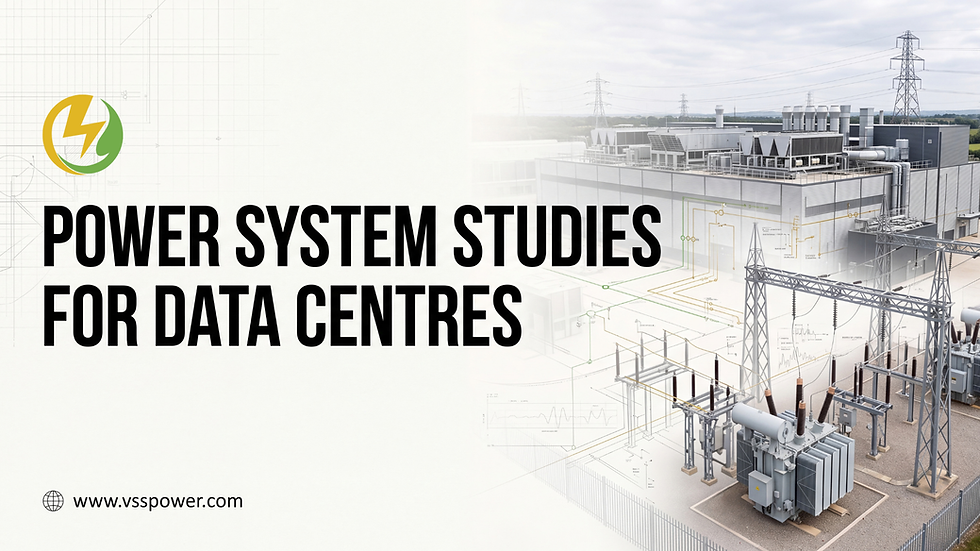
As data centres become the backbone of cloud computing, artificial intelligence, digital services and business operations, their dependence on reliable electricity continues to grow. A power interruption, voltage disturbance, or electrical fault can affect critical IT equipment and potentially cause significant operational and financial losses.
This makes data centre power systems study an important part of electrical design and engineering. These studies allow engineers to understand how an electrical network will perform under normal, abnormal, and future operating conditions before problems occur.
Every evaluation—whether it involves load flow and short-circuits analysis, protection coordination or power quality studies—concerns a particular aspect of the data centre's electrical performance.
What Are Power System Studies for Data Centres?
Power system studies for data centres involve modelling and analysing the facility’s electrical network to evaluate its performance, safety, reliability and capacity.
A typical data centre electrical system may include utility connections, transformers, medium-voltage and low-voltage switchgear, UPS systems, batteries, standby generators, cables, busbars and critical IT loads.
Since the various components function as a connected system, a change in one section of the network may have an effect on the rest of the equipment. Analysis of the power system enables engineers to determine these interactions and allow them to make informed decisions regarding the design.
Why Are Data Centre Power System Studies Important?
1. Improving Electrical Reliability
Data centres are built so that they can operate continuously and usually include a number of layers of redundancy. Yet having redundancy by itself does not ensure reliable operation.
It is necessary for engineers to know how the system performs when equipment is not available or when an electrical disturbance takes place.
Studies can analyse scenarios such as:
Utility supply failure
Transformer outage
Generator operation
Bus-section isolation
Large load connection
Equipment failure
Short-circuit faults
It enables weaknesses to be identified and helps in the development of a more robust electrical architecture.
2. Load Flow Analysis
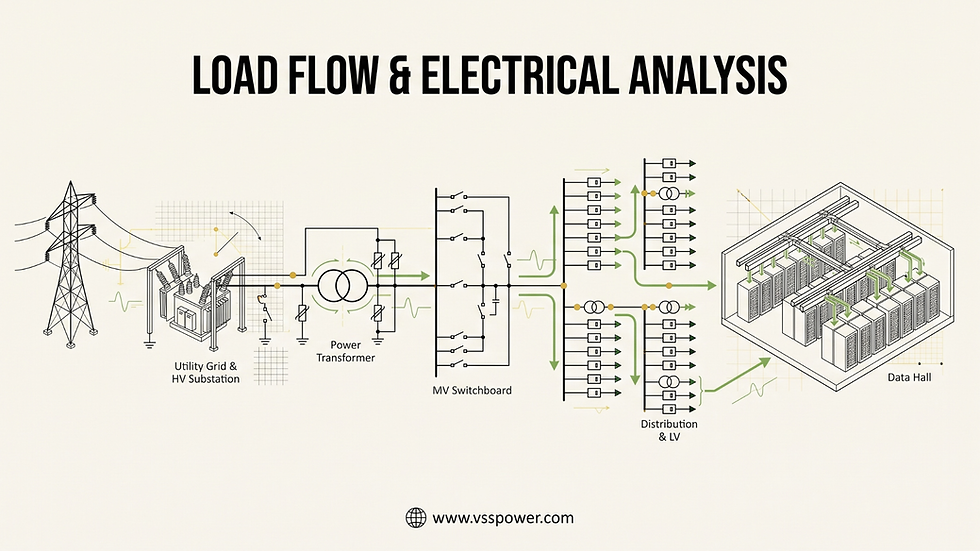
A data centre load flow study considers the movement of electrical energy within the network under various operational scenarios.
Engineers can assess:
Busbar voltage levels
Transformer loading
Cable loading
Power flows
Voltage drops
Reactive power
Potential overloads
Load flow analysis is particularly important for large data centres because electrical demand can increase significantly as additional server halls, cooling systems and supporting infrastructure are added.
Modelling current and future operating scenarios can help identify capacity limitations before expansion takes place.
3. Short-Circuit and Fault Level Studies
A data centre short circuit study determines the fault currents that may occur at different locations within the electrical network.
Fault currents can be much higher than normal operating currents. Therefore, switchgear and other electrical equipment must have suitable short-circuit withstand and interruption capabilities.
Short-circuit analysis can help engineers determine:
Maximum and minimum fault currents
Equipment fault ratings
Circuit breaker requirements
Protection requirements
Fault levels at different buses
It is important when choosing and checking electrical equipment to have this information.
4. Protection Coordination
A data centre protection coordination study examines how protective devices operate during electrical faults.
Protection systems may include circuit breakers, overcurrent relays, earth-fault protection, differential protection, and transformer protection.
The aim is to coordinate these devices so that a fault can be isolated appropriately while reducing unnecessary interruption to healthy parts of the electrical system.
Protection coordination is especially important in data centres because an incorrectly coordinated protection system could cause a fault in one section to affect a much larger portion of the facility.
5. Arc Flash Analysis
Arc flash analysis is another important element of electrical safety.
An arc flash study evaluates the potential incident of energy associated with electrical faults and can support appropriate safety measures for personnel working on or near electrical equipment.
The analysis may consider:
Fault current
Protective device clearing time
Equipment configuration
Working distance
Incident energy
The findings can be used to inform electrical safety procedures, equipment labelling, and maintenance planning.
6. Harmonic and Power Quality Studies
Modern data centres contain significant amounts of power electronic equipment, including UPS systems, converters and variable-speed drives.
These devices can introduce harmonic currents into the electrical network.
A data centre harmonic analysis can help identify issues such as:
Voltage distortion
Current distortion
Harmonic resonance
Transformer heating
Neutral conductor loading
Power quality problems
Engineers can then assess whether system changes or mitigation measures are required.
Generator and UPS System Analysis
Backup power systems are fundamental to data centre resilience.
During a utility outage, UPS systems may provide immediate continuity while standby generators take over the required load. The transition between different power sources needs to be carefully assessed.
Engineers may study:
Generator starting
Generator loading
UPS operation
Load transfer
Generator synchronisation
Multiple-generator operation
Voltage and frequency response
These studies can identify potential problems associated with sudden load changes or generator operation.
Dynamic and Transient Studies
For large and complex facilities, steady-state studies may not provide the complete picture.
Dynamic and transient analysis can examine how the electrical system responds to disturbances such as generator trips, large load changes, faults and utility interruptions.
These studies can help engineers understand changes in voltage and frequency and evaluate the interaction between generators, UPS systems and the wider electrical network.
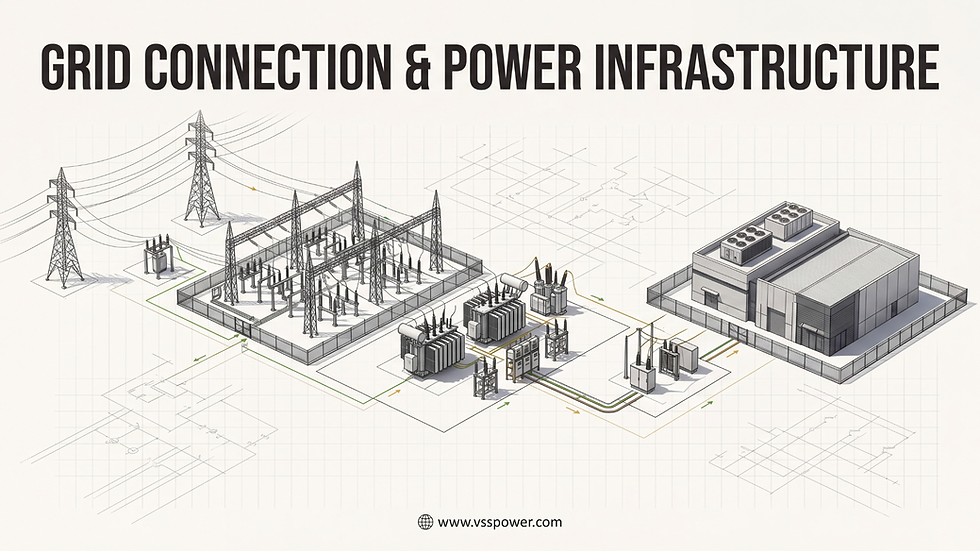
Data Centre Grid Connection Studies
Large data centres can represent substantial electrical loads, making their connection to the electricity network an important engineering consideration.
A data centre grid connection study may include load flow, fault level, voltage, harmonic, power quality and dynamic assessments.
These studies can help determine how the proposed facility interacts with the grid and identify technical requirements associated with the connection.
For projects in the UK, early assessment can also help developers understand potential network constraints and electrical requirements before progressing too far into detailed design.
Supporting Future Data Centre Expansion
Data centre capacity is often developed in phases rather than delivered as a single final installation.
A power system model can be used to analyse different stages, such as:
Initial capacity → Phase 1 → Phase 2 → Full build-out
Engineers can assess whether transformers, switchgear, cables and other electrical infrastructure can accommodate future demand.
This approach can reduce the risk of discovering major electrical constraints after construction has already begun.
What Information Is Required?
Reliable engineering data underpins accurate power system studies.
Typical inputs include:
Single-line diagrams
Utility network information
Transformer ratings and impedances
Generator specifications
UPS data
Cable sizes and lengths
Switchgear ratings
Protection relay information
Load schedules
Motor information
Earthing details
Operating configurations
Future expansion requirements
Incomplete data can affect the accuracy of the study, so information should be reviewed and validated before modelling.
Software Used for Power System Studies
Specialised engineering software is used to model and analyse data centre electrical networks.
Common platforms include ETAP, DIgSILENT PowerFactory, PSCAD, EMTP, CYMCAP and CDEGS.
The appropriate software depends on the study requirements. For example, load flow and short-circuit studies may use ETAP or DIgSILENT, while electromagnetic transient investigations may require tools such as PSCAD or EMTP.
Conclusion
Reliable electrical infrastructure is fundamental to modern data centre operations. Power system studies for data centres provide engineers with the analysis required to understand network performance, identify potential problems and support safe and reliable electrical design.
Load flow, short-circuit, protection coordination, arc flash, harmonic, power quality, dynamic and grid connection studies each address different aspects of the electrical system.
As data centres become larger and more power-intensive, particularly with the growth of AI and high-performance computing, detailed electrical analysis can become increasingly important.
VSS Power supports complex electrical engineering projects through services including electrical system studies, grid integration, protection and control engineering, HV substation design and commissioning support.
Frequently Asked Questions
What is a data centre power system study?
It is an engineering analysis used to assess the performance, safety, reliability and capacity of a data centre’s electrical network.
Which studies are commonly performed for data centres?
Common studies include load flow, short circuit, protection coordination, arc flash, harmonic, power quality, dynamic and grid connection studies.
Why is load flow analysis important for data centres?
It helps engineers evaluate voltage levels, equipment loading, power flows and potential overload conditions.
Are power system studies useful for future data centre expansion?
Yes, it is possible for engineers to model future load scenarios in order to determine if the existing electrical infrastructure can handle the extra capacity.
Why are grid connection studies important for large data centres?
They assist in evaluating the facility's interface with the power grid and determining possible technical needs or limitations.


Comments