Introduction to HVAC and HVDC: When and Why It's Used

Updated: Aug 31

With renewable energy projects moving further offshore and grids expanding across borders, utilities, EPC contractors, and transmission operators often face a key decision: should they use traditional AC cables or invest in a more expensive but efficient DC link? Choosing the wrong option can lead to high cable losses or spending too much on converter stations that aren't needed.
Understanding HVAC vs HVDC is no longer an academic exercise — it directly shapes project economics, land use, and grid stability. This article breaks down both technologies, when each makes engineering and financial sense, and what current UK projects reveal about the future of bulk power transmission.
What Is High Voltage AC Transmission?
High voltage AC transmission has supported power grids since the early 1900s. Electricity is generated, stepped up by transformers, sent over three-phase overhead lines or cables, and then stepped down where it is used. The main advantage is its simplicity. Transformers make voltage changes easy and affordable, and most equipment worldwide is designed for AC systems.
However, AC has physical limits. Alternating current constantly reverses direction, which means cables — especially long underground or subsea ones — generate reactive power (charging current) that has to be compensated. Beyond roughly 50–80 km for subsea cables, or 600–800 km for overhead lines, these losses make HVAC transmission increasingly uneconomical.
What Is HVDC Transmission?
HVDC transmission changes AC to DC at the sending converter station, sends it as direct current, and then changes it back to AC at the receiving end with an inverter. Since DC does not change direction, there is no reactive power loss along the line, no need for extra compensation, and power flow can be controlled accurately at both ends.
There are two dominant converter technologies:
Line-Commutated Converters (LCC)
Thyristor-based and proven over decades, LCC-HVDC systems handle very large bulk power transfers — like China's Changji–Guquan link, which moves 12,000 MW over 3,320 km at ±1,100 kV. LCC is robust but needs a strong AC grid at both ends to commutate against.
Voltage Source Converters (VSC)
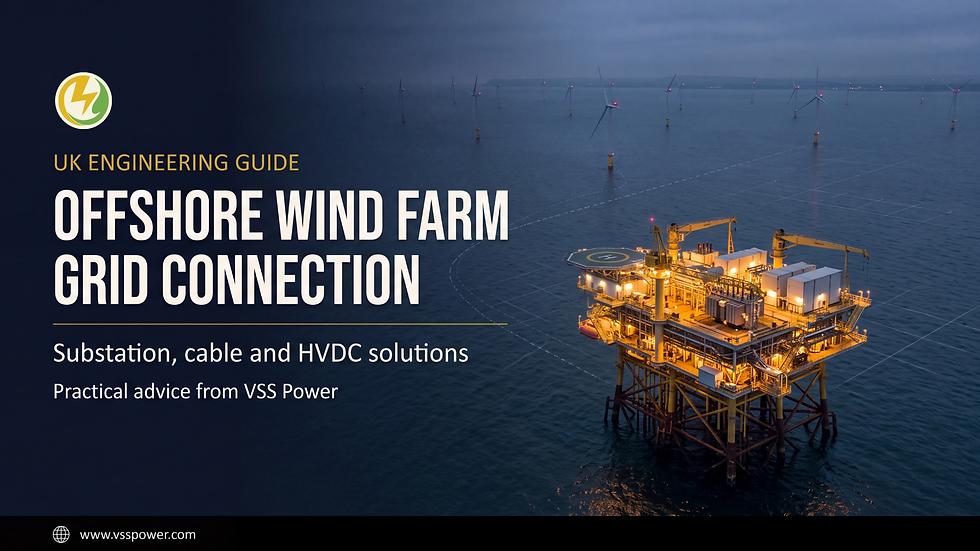
Built on IGBT technology, VSC-based high voltage direct current (HVDC) systems are more compact, support black-start capability, and can connect into weak or islanded grids. This makes VSC the technology of choice for offshore wind connections and multi-terminal interconnectors — precisely the projects reshaping the UK grid today.
HVAC vs HVDC: A Practical Comparison
Factor | HVAC Transmission | HVDC Transmission System |
Best distance | Under 600–800 km overhead; under ~50–80 km subsea | Long overhead and virtually unlimited subsea/underground |
Power losses | Higher over distance; reactive power losses in cables | Roughly 3% loss per 1,000 km; no reactive compensation needed |
Right-of-way / land use | Wider corridors, more towers | 30–40% narrower corridors for equivalent capacity |
Grid synchronisation | Requires synchronised frequency at both ends | Connects asynchronous or different-frequency grids |
Initial cost | Lower for short distances (no converters) | Higher upfront (converter stations), lower for long distances |
Control of power flow | Limited; needs FACTS devices for control | Precise, bidirectional control at converter stations |
Typical UK application | Onshore substation-to-substation links | Subsea interconnectors, offshore wind, long-distance bulk transfer |

Why UK and European Grids Are Turning to HVDC
The UK's transmission strategy makes the HVAC vs HVDC trade-off concrete. National Grid's Eastern Green Link projects (EGL1–EGL4) use 525 kV HVDC transmission system links to move offshore wind power from Scotland to England, bypassing constrained AC corridors at the Scottish border. The Viking Link connecting Britain and Denmark — at 475 miles, one of the world's longest interconnectors — was built as an HVDC link precisely because AC would have suffered unacceptable cable losses over that distance.
Similarly, multi-purpose interconnectors like LionLink and Nautilus are being designed to do double duty: connecting offshore wind farms to shore while also linking the GB grid to continental Europe. This "hybrid asset" model only works with HVDC because it allows independent control of power flow direction and volume — something AC interconnection cannot offer without extensive FACTS infrastructure.
HV Substation Design Considerations
HV substation design for UK projects needs to balance converter station footprint, insulation coordination, and grid code requirements. Major considerations are:
Insulation coordination of converter stations is based on a simplified version of IEC 60071-11, which has a specific section devoted to LCC and VSC HVDC equipment on its withstand voltages and clearances.
Protection and automation increasingly follow IEC 61850 for digital substation communications, replacing hardwired schemes with GOOSE messaging for faster fault clearance.
Reliability planning for HVDC converter stations is guided by IEEE Std 1240, which utilities are used for long-term asset and maintenance planning.
Site selection must account for converter hall footprint, harmonic filter banks, and cooling requirements — all larger than an equivalent AC switching station.
Compliance with the grid code (National Grid ESO’s Grid Code and BS EN harmonised standards) sets the requirements for fault ride-through, provision of reactive power support, and black-start duties that new connections are expected to comply with.
Choosing the Right System: A Quick Checklist
Distance less than 50 km under sea or 600 km overhead, both ends in the same synchronous grid → HVAC transmission is generally more cost-effective.
Long subsea or underground cable routes or connecting asynchronous grids → HVDC transmission leads to losses and control.
Offshore wind farms beyond ~80–100 km from shore → VSC-HVDC is now close to standard practice across UK and European projects.
Need for precise power flow control between two grids, or multi-terminal hybrid assets → HVDC converter stations are essential.
Budget-constrained, shorter-distance onshore reinforcement → HVAC remains the lower-capex option.

Conclusion
HVAC and HVDC transmission each have their advantages. The optimal selection depends on distance, grid synchronisation, and project costs. As offshore wind developments extend out to sea and grids link cross? -border, HVDC is emerging as the default for new long-distance power links. High voltage AC transmission is still used for shorter, synchronised onshore connections.
For utilities, EPC contractors, and transmission operators navigating this decision, getting the substation design, converter technology, and standards of compliance right from the outset is critical to project bankability and long-term reliability. VSS Power works with clients across the UK, Europe, the Middle East, and India on HV and HVDC substation design, engineering studies, and project delivery — get in touch to discuss your next transmission project.
Key Takeaways
HVAC transmission remains the cost-effective option for shorter, synchronised land links and long-distance as well as undersea routes; HVDC transmission is the winner.
HVDC losses are about 3% at 1,000 km, with line compensation for reactive power.
VSC-based high voltage direct current (HVDC) technology is now the standard for offshore wind connections due to its black-start capability and compact converter footprint.
UK flagship projects like Eastern Green Link and Viking Link demonstrate HVDC's role in bypassing grid constraints and connecting asynchronous grids.
High voltage substation design in the UK should agree with standards of IEC 60071-11, IEC 61850, and IEEE Std 1240.
FAQs
1. What is the main difference between HVAC and HVDC transmission?
HVAC transmission carries alternating current and needs reactive power compensation over distance, while HVDC transmission carries direct current with lower losses and precise power flow control, making it better suited to long distances and subsea cables.
2. When should a project use HVDC instead of HVAC?
It is usually favourable to consider HVDC transmission for projects due to longer distances of approximately 50 to 80 km under sea or 600 to 800 km overhead, or when connecting grids that are not frequency-synchronised, such as if using international interconnectors.
3. Why are UK offshore wind projects increasingly using HVDC?
Offshore wind farms are going further out to sea, where AC cable losses become uneconomic. VSC-HVDC provides reduced losses and a smaller offshore platform footprint and the possibility to link into practically any weak grid nodes.
4. What standards govern HVDC substation and converter station design?
Relevant standards include IEC 60071-11 for insulation coordination, IEC 61850 for digital substation communication, and IEEE Std 1240 for converter station reliability planning.
5. Is HVDC transmission more expensive than HVAC?
The initial capital cost is higher for HVDC transmission system projects because of the cost of converter stations, but for long distances, the lower line losses and right-of-way requirements make HVDC the more economical option overall.

Comments