Case Study: Multi-Site Substation Programme Delivery with Zero Lost-Time Incidents

Updated: Aug 31

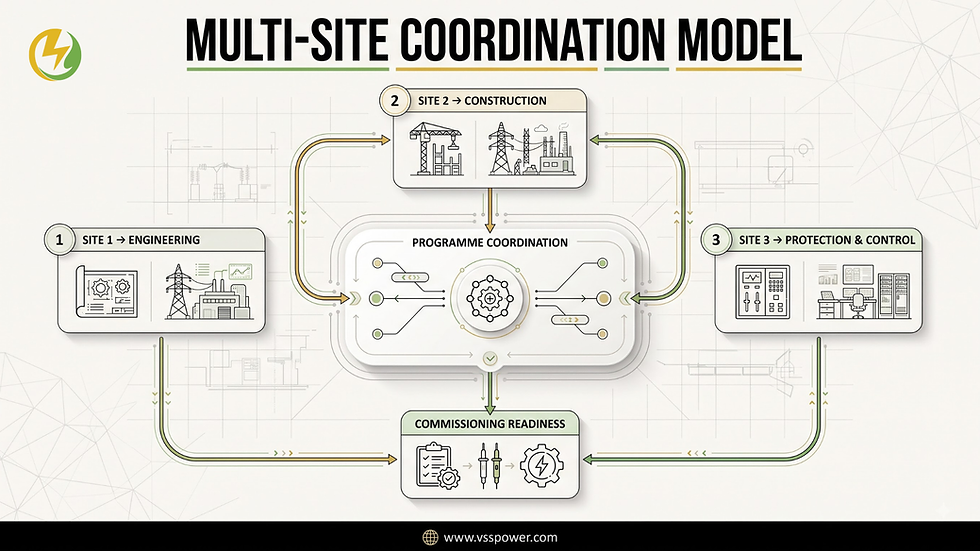
A multi-site electrical program presents the typical challenge of delivery: all sites may have their own sequence, interfaces, contractors, design constraints, and risks, but the program has to act as a single, controlled program. The separation of engineering decisions, site activities, and stakeholders' decisions can lead to technical questions delaying the programme, design changes resulting in rework, and differing safety controls across sites.
This case study examines VSS Power’s approach to multi-site substation programme delivery, based on a coordinated engineering programme across multiple locations. The focus was not simply on completing individual tasks, but on creating consistent control across engineering, interfaces, programme risk, quality, and safety.
Why Multi-Site Substation Programmes Are Difficult
The management of the substation project requires a programme-wide perspective. Success can be gauged not only by the completed drawings and construction work, but also by the status of interfaces, technical questions, design modifications, site issues, commissioning interdependencies, and outstanding risks.
For electrical substation projects, maintaining consistency across locations is particularly important when several engineering teams, contractors and delivery partners are involved.
The Delivery Approach
VSS Power applied a structured approach built around five stages:
Plan → Coordinate → Execute → Monitor → Improve
1. Programme Coordination Across Sites
The priority was visibility. Activities across locations were coordinated through programme planning, progress monitoring, status reviews, and early escalation of risks.
Critical activities were identified to prevent delays at one interface from going unnoticed until they affected construction or commissioning. This is a core principle of substation construction management: programme control must connect engineering decisions with what is happening on site.
2. Engineering and Interface Control
Multi-disciplinary interfaces can become a major source of rework. Electrical design, protection and control, equipment interfaces and substation layouts must remain aligned as information develops.
The programme therefore included the review and coordination of engineering deliverables, technical query management, design reviews, and controlled change management.
For UK projects, technical compliance should be considered against applicable project specifications, network requirements, and relevant standards. IEC 61936-1:2021, for example, establishes requirements for the design and erection of AC power installations above 1 kV, with the objective of safety and proper functioning.
Where generation connects to Great Britain's distribution networks, applicable ENA requirements also need to be considered. EREC G99 Issue 2 defines technical requirements for Type A to Type D Power Generating Modules connected in parallel with licensed DNO networks.
3. Safety as a Delivery Control
There is no way to achieve zero-LTI if safety is treated as a separate compliance activity. It is rather about embedding safety in planning, coordination, communication, and execution.
The programme maintained focus on risk awareness, clear responsibilities, appropriate planning and communication between engineering and site teams.
This aligns with UK HSE guidance, which addresses safe practices across the design, specification, installation, commissioning, maintenance and operation of electrical systems during construction.
For projects involving multiple contractors, CDM 2015 also places strong emphasis on planning, managing, monitoring and coordinating construction work. HSE states that principal contractors must coordinate the construction phase and maintain a suitable construction phase plan.

Zero Lost-Time Incidents: What It Demonstrates
The programme achieved:
ZERO LOST-TIME INCIDENTS (LTIs)
The result demonstrates the importance of combining proactive risk identification, clear accountability, communication, and planned execution.
When dealing with multiple sites, consistency is very important because good safety practices cannot be entirely dependent on personal behaviour or subjective interpretation. There must always be a risk of consciousness in program coordination.
A useful performance framework is:
Delivery Control | Practical Focus | Programme Value |
Planning | Sequence, resources, critical activities | Fewer avoidable delays |
Engineering control | Reviews, interfaces, changes | Less rework |
Risk management | Early identification and escalation | Better decisions |
Communication | Responsibilities and reporting | Faster issue resolution |
Safety | Risk awareness and safe execution | Reduced exposure |
Managing the Path Toward Commissioning
The final stages of a substation programme bring together design intent, installed equipment, protection settings, control logic, documentation, and operational readiness.
HV substation commissioning should be treated as an engineering exercise, not an administrative task.
Readiness for HV substation commissioning will require questions regarding design and engineering to be addressed early on, as well as accurate documentation of interfaces between engineering and the construction side. The high-level look at the program may help avoid a common problem in which individual elements are completed, but an essential prerequisite is overlooked.
For organisations delivering HV substation design projects in the UK, this is particularly relevant where network requirements, client standards and regulatory expectations must be reflected consistently from design through commissioning.
Key Outcomes
Programme benefits include:
Integrated implementation at various substation sites.
Engineering and project standards that were standardised.
Increased risk awareness and project visibility.
Proactive management of technical issues and changes.
Collaboration between engineering teams, contractors, and stakeholders.
Continued focus on quality and compliance.
Zero lost-time incidents throughout programme delivery.
Key Takeaways
Treat a multi-site programme as one integrated delivery system, not a collection of independent sites.
Connect engineering deliverables to construction, interfaces and commissioning dependencies.
Make technical queries and design changes visible at programme level.
Build safety and risk management into planning and coordination.
Regular progress reports can also be used to detect emerging risks at an early stage and to take corrective action.
FAQs
What is multi-site substation programme delivery?
It is the application of engineering, construction, interface management, and commissioning activities for multiple substation sites within a programme arrangement.
Why is programme coordination important for substations?
It provides visibility of dependencies, risks, technical issues, and critical activities so that problems at one interface can be addressed before they affect wider delivery.
How can substation projects improve safety?
Safety is enhanced when duties are clearly defined, hazards anticipated, work is adequately planned, and when engineering and field work groups are in continuous communication. UK HSE guidance highlights this holistic approach.
What standards may apply to UK substation projects?
Specifications are based on project size and network connection. IEC 61936-1 is also applicable for AC power systems above 1 kV, but in addition to this, there may be other standards, such as relevant ENA engineering recommendations, client standards and network standards that the client has specific to the project.
What does zero LTI mean in a substation programme?
Zero lost-time incidents mean no workplace incident during the programme resulted in lost work time under the applicable reporting definition. It is a valuable safety indicator, but it should be supported by broader proactive safety controls.
Conclusion
The delivery of a successful multi-site substation programme requires rigorous planning and control across engineering, programme management, risk, quality, and health and safety. This case study demonstrates how a frameworked approach can establish consistency across sites, while site-specific challenges must be addressed. The result was controlled programme delivery with zero lost-time incidents.
VSS Power supports complex substation programmes through engineering coordination, technical expertise, and safety-focused delivery practices. Contact VSS Power to discuss your next substation programme or engineering requirements.


Comments