5 Trends Shaping Electrical Substation Design for the Energy Transition

Updated: Aug 29

Today's utility companies are being asked to carry out something that they have never had to do on this scale: linking up gigawatts of intermittent renewable energy, taking in the spikes in demand from data centres and electric vehicle charging, and replacing the infrastructure which, in many areas, predates the 1970s—all while reducing emissions and keeping costs low for consumers. It is this particular piece of infrastructure that is feeling the pressure.
For many years, substation developments proceeded at a slow pace, with copper cabling, electromechanical relays, and construction periods spanning several years as the norm. That period is now coming to an end. Electrical Substation design has become one of the most rapidly changing fields in power engineering, and the decisions made today will determine how resilient, flexible, and future-ready the grid will be over the next 30 to 40 years. The following are five trends that are truly altering the way substations are planned, constructed, and operated.
1. Digital Substations Are Becoming the Default, Not the Exception
The move from copper-wired protection schemes to fibre-optic process buses based on the IEC 61850 communication standard is no longer experimental; it has become the standard practice. Intelligent Electronic Devices (IEDs) are now performing the functions of protection, control, and monitoring that used to be handled by racks of hardwired relays, greatly reducing both cabling costs and commissioning time.
The advantages in terms of practicality extend beyond the initial installation costs. The digital substations produce a constant stream of operational data which is fed directly into asset management and predictive maintenance systems, enabling engineers to detect developing faults—such as a deteriorating bushing or a stressed transformer winding—before they lead to an outage. This aspect forms a key element of the current grid modernisation strategy, and utilities in North America, the Middle East, and throughout Europe are progressing from pilot projects to full-scale implementations.
For design teams, this means that protection and SCADA architecture must be planned from the very beginning to incorporate a digital process bus, rather than adding it later. The cybersecurity architecture must be designed in parallel with the rest, since a fully networked substation also constitutes an attack surface.
2. SF6-Free Switchgear Is Reshaping Equipment Specifications
Sulfur hexafluoride (SF6) has for many years been the insulating gas preferred by the industry due to its outstanding dielectric properties. It is also one of the most powerful greenhouse gases identified; its global warming potential being thousands of times greater than that of CO2. This is causing a change in regulation which every specifying engineer now has to take into consideration.
According to the EU's F-Gas Regulation (EU 2024/573), the use of SF6 in new medium-voltage switchgear of up to 24 kV will be banned from January 2026, the ban extending to 52 kV by 2030, and all new circuit breakers must be SF6-free by 2032. The UK is preparing similar legislation, and California has introduced a comparable phase-out. Among the alternatives that are already approved under IEC 62271 are vacuum interrupters, dry-air insulation and low-GWP gas mixtures — many of which currently match traditional SF6 equipment in terms of footprint and reliability.
Practical implication: procurement and design specifications drafted as far back as two years ago may now be obsolete. Before finalising the equipment lists for any new project or refurbishment, engineering teams assessing High Voltage Substation Solutions should check with manufacturers to confirm SF6-free compliance routes.
3. Modular and Factory-Built Substations Are Cutting Delivery Times
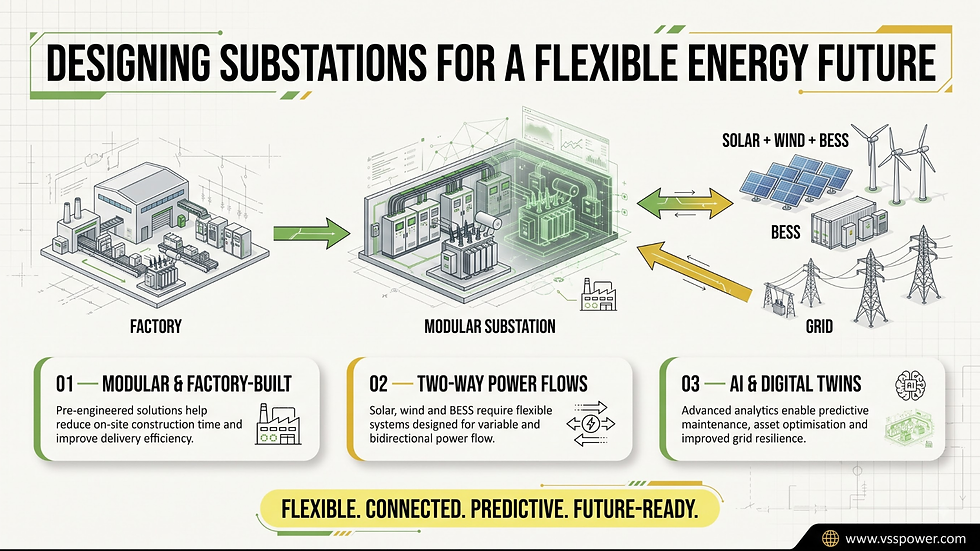
In many markets, queues for grid connections have grown over many years, so the speed at which connections are made is now at least as important as engineering quality. Substation modules that are factory-made and pre-assembled — built and tested in a controlled environment before being dispatched to the site — are increasingly used as a replacement for fully on-site construction.
Case studies on the use of modular buildings, which have been given at recent industry conferences, indicate that modular constructions are able to cut weeks from on-site construction programmes and at the same time improve safety, as there is less work carried out at height or in live environments. The method also provides a solution to a long-standing problem in the industry — the declining number of skilled workers. By standardising designs so that they can be manufactured in a factory and assembled in a repeatable way, the need for the scarce specialist site labour is reduced.
Modular construction is especially well suited to distribution and sub-transmission voltage projects—consider for example renewable interconnection points, EV charging hub substations, and quick EPC contractor deployments in the Middle East and India, where project timelines are often the key commercial consideration.

4. Substations Are Being Designed for Two-Way, Variable Power Flows
Traditional substations were designed with one-way power flow in mind—starting at the point of generation, passing through the transmission system, and then reaching the end of users. However, renewable energy developers who are connecting solar farms, wind power facilities, and ever-increasing numbers of battery energy storage systems (BESS) have overturned this idea. Power is now flowing in both directions; output varies from hour to hour, and voltage regulation must respond dynamically rather than statically.
This is prompting electrical design and engineering teams to adopt flexible bus arrangements, dynamic reactive power compensation, and substation layouts that can incorporate storage assets alongside conventional transformers and switchgear—usually within the same area originally designed for a simpler connection.
Design checklist for renewable-ready substations:
Coordination and setting of bidirectional protection relays
Reactive power/voltage support equipment sized for variable generation
Physical and electrical provision for future BESS integration
Communication architecture (IEC 61850) that can scale as more assets connect
Harmonics analysis and study related to inverter-based generation
5. AI-Driven Monitoring and Digital Twins Are Moving Into Daily Operations
Digital substations generate huge amounts of operational data, and it is now AI-based analytics that convert this data into decisions. By using digital twin models, engineering teams are able to simulate different loading situations, plan their maintenance periods, and test responses to potential problems without having to work on the live equipment. When combined with IoT sensors and automation, this is becoming what various industry analysts refer to as intelligent, self-monitoring infrastructure.
As far as engineering managers and power transmission companies are concerned, it is not innovation but value that counts fewer unscheduled outages, greater asset service life, and maintenance costs allocated based on equipment needs rather than adhering to a fixed schedule.
Comparison at a Glance
Trend | Primary Driver | Who It Affects Most |
Digital substations (IEC 61850) | Grid modernization, data-driven maintenance | Utilities, transmission operators |
SF6-free switchgear | F-Gas Regulation, emissions targets | EPC contractors, equipment specifiers |
Modular/factory-built substations | Speed of delivery, workforce shortages | Renewable developers, industrial plants |
Bidirectional, renewables-ready design | Solar, wind, BESS integration | Power generation companies, developers |
AI monitoring & digital twins | Predictive maintenance, resilience | Engineering managers, asset owners |
Conclusion
The same can be said of all five trends: substations are no longer fixed and serve a single function; instead, they are becoming dynamic, data-rich, and being built for a grid that is fundamentally different from the one for which they were originally designed. Those utility companies, EPC contractors and renewable developers who regard the design of electrical substations as a strategic choice—rather than as a standard to meet accelerating procurement tasks—will be well positioned as connection demand increases over the next ten years.
If you are intending to carry out a new build, an upgrade, or a renewable energy interconnection project and would like to discuss these design choices with an experienced partner, then VSS Power's engineering team collaborates with utilities, EPC contractors, and industrial clients in the UK, Europe, the Middle East, and India in order to provide substation solutions that are designed with the future of the grid in mind rather than merely being based on the grid's past.
Contact VSS Power to talk about your next project.
Key Takeaways
The use of digital substations based on IEC 61850 is now well established and no longer in the experimental stage—cybersecurity should be planned from the beginning.
Before finalising any new equipment specification, it is necessary to confirm compliance with the requirements for SF6-free switchgear as set out in IEC 62271 and the EU F-Gas Regulation.
Substations built in factories in a modular fashion are reducing construction time and alleviating pressure from the shortage of skilled labour.
Substations must be designed from the outset to handle bidirectional, variable power flow as part of integrating renewable energy and storage.
Maintenance is shifted from a calendar-based to a condition-based approach through AI-driven monitoring and digital twins, reducing the number of unexpected outages.
FAQs
1. What is driving the biggest changes in electrical substation design today?
The combination of renewable energy integration, ageing infrastructure replacement, and digital communication standards such as IEC 61850 is the primary driver of current grid modernisation efforts.
2. Why are utilities moving away from SF6 gas in switchgear?
SF6 has a very high global warming potential, and regulations such as the EU’s F-Gas Regulation are making the use of SF6-containing equipment in new medium-voltage switchgear prohibited, prompting the industry to look at vacuum and dry-air alternatives.
3. How do digital substations differ from conventional ones?
The main difference between digital substations and conventional substations is that the former use optical fibres instead of wires for communication.
4. Are modular substations reliable compared to traditionally built ones?
Absolutely – modules used in modular substations are manufactured in factories and tested there, which may improve quality control while reducing on-site installation time.
5. What should renewable energy developers consider in substation design?
Developers must ensure bidirectional protection in their scheme, dynamic reactive power provision, and good communication infrastructure to cope with the increasing number of interconnected devices.


Comments