Offshore Wind Farm Projects: Grid Connection Challenges and Engineering Solutions

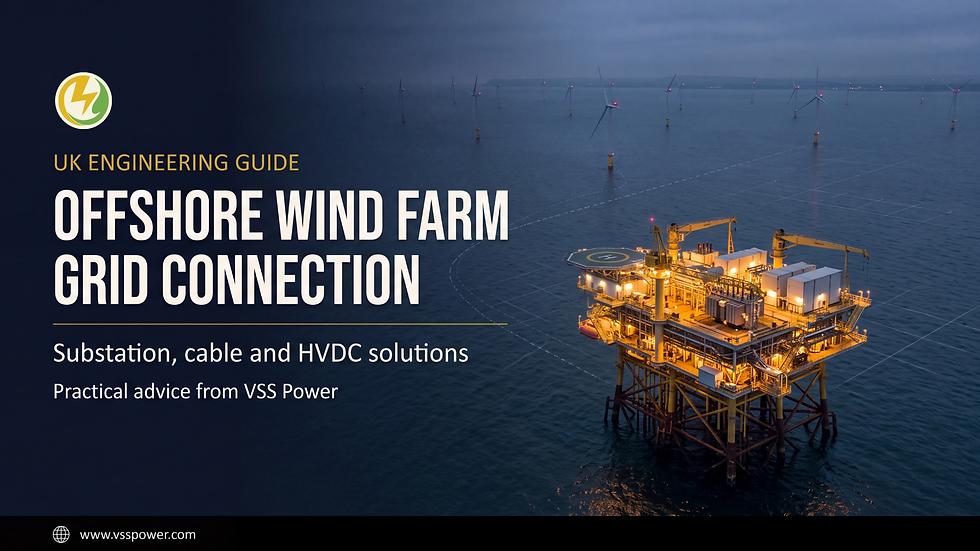
Connecting an offshore wind farm to the onshore network is now the hardest part of delivering offshore wind power in Great Britain. The turbines are proven. The difficult questions sit between the turbine and the point of connection: how to design the platform, which cable system to use, how to keep the plant stable on a changing grid, and when a connection date will actually arrive.
The scale makes this urgent. In January 2026, the UK's seventh Contracts for Difference round (AR7) awarded a record 8.4 GW of offshore wind energy [1], against a 2030 ambition of 43–50 GW [2].
Each project needs a workable grid route, and every offshore wind farm on that list will be judged on how well it connects. For developers, EPC contractors and transmission operators, offshore wind grid connection engineering is where schedules are won or lost.
This guide covers the main technical and commercial challenges facing an offshore wind farm and the engineering responses that work on UK projects. Much of it also applies to developers in Europe, the Middle East and India planning their own offshore wind farm portfolios.
Why Grid Connection Is the Critical Path
For many years, each offshore wind farm had its own radial connection with the mainland. Although this arrangement worked on a small scale, a single link for each offshore wind farm is not viable when total capacity reaches 50 GW. National Grid ESO's Holistic Network Design (HND), published in 2022, recommended a coordinated approach to offshore and onshore infrastructure for 23 GW of new capacity [3]. The study predicted an additional capital cost of £7.6 billion, more than offset by £13.1 billion in savings on constraint costs, and up to a third fewer cables coming onshore [4].
The queue is the second constraint. NESO's Connections Reform replaced "first come, first served" with a Gate 1 and Gate 2 process, working through a backlog of roughly 739 GW [5]. Its first results showed 132 GW could connect before 2030 [6]. Projects now need to prove readiness [7], so technical maturity matters: a credible single-line diagram, early studies and survey data all strengthen an application for an offshore wind farm project.
Challenge 1: Offshore Wind Substation Design
Offshore wind substation design is a weight, schedule and reliability problem at once. Platform fabrication slots are tight, and every additional tonne impacts the cost of the foundation and the installation for the offshore wind farm.
Practical measures:
Standardise early. By using the same platform design across phases, you reduce engineering ,time and lower procurement risk.
Design for N-1. Size transformers and switchgear so the entire plant does not have to stop operating during a single outage.
Choose proven equipment. Using power transformers conforming to IEC 60076, gas-insulated switchgear to IEC 62271-203, and substation communications to IEC 61850 will reduce interface surprises.
Minimise offshore intervention. Remote operation, condition monitoring and corrosion protection keep vessel visits low.

Electrical studies should feed the design before it freezes. Transformer impedance, reactor sizing and protection settings all depend on them, and changing them after fabrication is expensive.
Challenge 2: Offshore Wind Export Cable Design
Offshore wind export cable design carries most of the project's physical risk. Cable damage and installation delays are always among the most expensive incidents on an offshore wind farm.
In HVAC systems, long cables cause large charging currents that consume thermal capacity and therefore require reactive compensation; in practice, HVAC export links are generally limited to about 80 to 120 km, depending on the voltage and cable size.
Good practice includes:
Conducting detailed route surveys and burial risk assessment prior to selecting the cables
Thermal analysis taking into account burial depth, backfill, and crossings
Designing the cable in accordance with IEC 60840 (up to 150 kV) and IEC 62067 (above 150 kV)
Developing a weather window plan for installation and a repair plan, including spare cable
Landfall design, usually Horizontal Directional Drilling, in close cooperation with consenting groups
Challenge 3: HVAC or HVDC Offshore Wind Transmission Systems
The choice between AC and DC is the biggest architectural decision in offshore wind transmission systems.
Factor | HVAC | HVDC (VSC) |
Best suited to | Shorter links, smaller farms | Long distances, large clusters |
Reactive power | Cable charging current limits length | No charging-current limit |
Offshore platform | Smaller, simpler | Large converter platform |
Losses | Rise with length | Lower over distance, plus converter losses (about 1% per station) |
Supply chain | Mature | Constrained, long lead times |
HVDC is increasingly central in Britain. National Grid's Eastern Green Link 5 proposal includes up to 423 km of subsea HVDC cable [8], and the HND uses HVDC links to a shared connection point so future projects can join [4], [9]. The trade-off is converter lead time, so order slots matter as much as electrical design.
Challenge 4: Offshore Wind Grid Integration and System Studies
The compliance examination for offshore wind grid integration is often the most difficult phase projects must go through. Converter-based plants interact with cables, transformers, and the grid, and the grid's strength is decreasing as synchronous generation is retired.
The following should be considered in a complete study:
Load flow and short-circuit studies to verify the thermal limits and fault levels
Harmonic studies against IEEE 519 and the UK's Engineering Recommendation G5, because long cables create resonance risk
EMT (electromagnetic transient) studies for fault ride-through and control interaction, with validated manufacturer models
Compliance with the Grid Code, including reactive power capability and growing expectations around grid-forming control
Reference to IEEE 2800 and IEC 61400-21-1 for inverter-based resource performance and power quality
Submit models as soon as possible. Final turbine data not being ready is the most frequent reason behind delayed analyses and resubmissions.
What UK Developers Should Do Next
The takeaway from AR7 and the Connections Reform is that developers must treat the grid as a design input, not an afterthought. Before designing your layout, ensure from the transmission owner what the probable connection site would be and when, and evaluate at least two connection scenarios, for instance, a radial HVAC connection and an HVDC connection in common with other plants. The assumptions behind each connection scheme must be documented.
Owners of existing assets should also revisit their position. Retrofit studies, compensation upgrades and updated models can keep an operating offshore wind farm compliant as Grid Code expectations evolve.
Improving Reliability and Project Delivery
Four habits consistently help on a UK offshore wind farm project:
Agree interfaces early between the developer, the transmission owner and OFTO, since late changes have an effect that spreads across the contracts.
Reserve supply chain capacity for HVDC equipment, cable and platform fabrication.
Install monitoring, such as distributed temperature sensing in cables, so degradation is detected before it becomes a failure.
Run studies in parallel with design, not after it.

Conclusion
A successful offshore wind farm depends as much on the grid connection as on the turbines. Substation design, export cables, the choice between HVAC and HVDC, and integration studies are all related decisions, and it is cheaper to get them right from the start. Since the current reform provides incentives for readiness, well-prepared projects will move first.
VSS Power's electrical power systems engineers support developers, EPC contractors and transmission operators with electrical system studies, grid compliance and design review. To discuss your next project, contact VSS Power at vsspower.com.
Takeaways
Grid connection, not turbine supply, is now the critical path for a UK offshore wind farm.
NESO's Connections Reform rewards projects that can show technical readiness early.
Substation design should be standardised, N-1 compliant and informed by early electrical studies.
HVAC is more suitable for shorter distances while HVDC is appropriate for long distances and large groups, although it does require early reservation of supply chain slots.
The harmonic, EMT and Grid Code studies should be carried out in parallel with the design and must use validated models.
FAQs
1. What is the biggest grid connection challenge for an offshore wind farm?
The biggest challenge is matching engineering readiness with the connection date. Even after the turbines are installed, energisation can be delayed by lead times for the substation, cables, and converters, as well as the NESO Gate 2 queue.
2. When is HVDC used for offshore wind transmission?
HVDC is generally considered for long export distances and when many wind farms are involved, since the charging current of HVAC cables becomes a limiting factor. HVAC export lines are usually feasible up to about 80 to 120 km, depending on the voltage and cable size.
3. Which standards apply to offshore wind export cables?
IEC 60840 applies to power cables with a voltage level between 30 kV and 150 kV, and IEC 62067 applies to cables with a voltage level between 150 kV and 500 kV. The project specifications also refer to guidance concerning installation, burial and thermal rating.
4. What electrical studies are needed for offshore wind grid integration?
Standard simulations include load flow analysis, short circuit study, harmonics, EMT simulation and Grid Code compliance study. Validate the models through manufacturer data and update them accordingly as per the progressing design process.
5. What is NESO Connections Reform?
It is a gate-based procedure that replaces the first-come, first-served system for allocating GB transmission and distribution connections; to receive a Gate 2 offer with a firm connection date, projects must meet the readiness and alignment criteria.
Reference Links
AR7 results, 8.4 GW offshore wind (Osborne Clarke): https://www.osborneclarke.com/insights/energy-transition-uk-government-announces-results-record-breaking-cfd-ar7-auction
AR7 and the 43–50 GW 2030 target (Energy Institute): https://knowledge.energyinst.org/new-energy-world/article?id=140068
Holistic Network Design for offshore wind (NESO): https://www.neso.energy/publications/beyond-2030/holistic-network-design-offshore-wind
HND summary and cost figures (Addleshaw Goddard): https://www.addleshawgoddard.com/en/insights/insights-briefings/2022/energy/holistic-network-design-first-step-towards-centralised-strategic-network-planning/
Connections Reform queue backlog and gate process (Greenberg Traurig): https://www.gtlaw.com/en/insights/2025/4/uk-grid-connection-reforms-breaking-the-bottleneck
NESO Gate 2 results, 132 GW before 2030 (Solar Power Portal): https://www.solarpowerportal.co.uk/solar-planning/uk-grid-connections-reform-132gw-renewables-to-connect-by-2030
Connections Reform update (SSEN): https://www.ssen.co.uk/our-services/new-supplies/large-new-connections/connections-reform/
Eastern Green Link 5 overview (National Grid): https://www.nationalgrid.com/document/584846/download
Holistic approach to offshore transmission planning in GB (NESO / DNV / National HVDC Centre): https://neso.energy/document/177221/download

Comments