What Is a GIS and AIS Substation? A Complete Guide for Utility Engineers
- VSS Power

- Aug 1
- 5 min read

As demand for electricity grows along with renewable energy plants, utilities have to invest in substations that are reliable, compact, and cost-effective. Deciding whether to use GIS and AIS substation technology is an important engineering consideration that affects the project's costs, reliability, maintenance, and development in the future.
The gas insulated substations and the air insulated substations play the same role within the power transmission system but differ in their construction, installation processes, and suitable environments. Understanding these differences enables engineers to choose one solution over another for cities, industries, renewable energy plants, and networks.
Quick Summary
What is it? Two technologies used in a high-voltage substation to switch, protect, and control electrical power.
Why is it important: The right choice improves reliability, safety, and lifecycle costs.
Who needs it: Utilities, EPC contractors, renewable developers, industrial plants, and electrical consultants.
Main advantage: Selecting the appropriate technology ensures an efficient, future-ready grid infrastructure.
What Is a GIS and AIS Substation?
A high-voltage substation transfers electrical power between transmission and distribution networks. It also handles switching, protection, voltage changes, and system control.
A Gas Insulated Substation (GIS) encloses its bus bars, circuit breakers, disconnectors, and other live components in metal modules filled with insulating gas under pressure. This tight package keeps the equipment clean and protected from contamination, water, and bad weather, so it’s ideal for small-space applications.
Air-Insulated Substation (AIS) in which air is the insulating medium. The equipment is located in open switchyards, with ample space between units to facilitate inspections, at relatively low cost for site preparation and installation, and with room to grow.
Both technologies perform the same electrical functions, but the best choice depends on your project's needs, how much land you have, the environment, your maintenance plans, and long-term goals.
How Do GIS and AIS Substations Work?
Both technologies have the same role in a power transmission system: they receive, switch, protect, and distribute high-voltage electricity. The main difference is how they insulate the equipment.
In a Gas Insulated Substation (GIS), the main equipment is inside sealed metal chambers filled with insulating gas. This compact design requires less space between parts, improves reliability, and keeps equipment safe from dust, moisture, and pollution.
Air Insulated Substation (AIS) uses air for insulation. The equipment is set up in an open switchyard with bigger safety gaps, which makes inspection, maintenance, and future expansion easier.
The best selection depends on your project’s needs. No single technology is always better.
Engineering Design Considerations
Engineers look at numerous factors before choosing between GIS and AIS substations:
Available land and site constraints
Environmental conditions such as pollution, humidity, and coastal exposure
Voltage level and fault current requirements
Lifecycle cost, not just capital expenditure
Maintenance accessibility and future expansion
Compliance with IEC, IEEE, BS EN, and National Grid standards
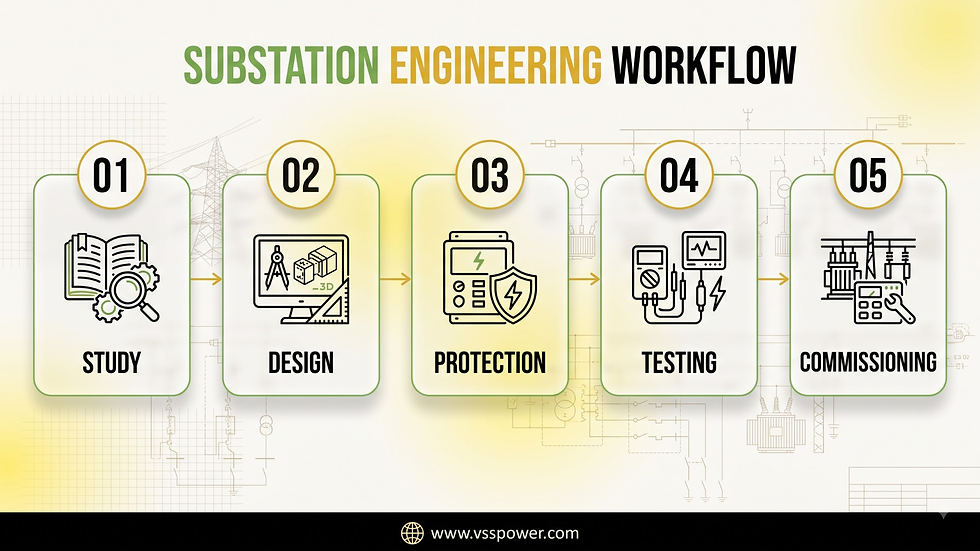
It is important to have proper system studies, protection planning, earthing arrangement, and insulation tests for reliability.
Industry Applications
GIS is commonly used for:
Urban substations
Offshore wind farms
Renewable energy projects
Underground installations
Industrial facilities with limited space
AIS is preferred for:
Rural transmission networks
Conventional power stations
Large industrial plants
Utility substations with sufficient land
Advantages and Limitations

Safety and Future Trends
Both technologies require robust protection and proper grounding and must meet international standards. Substations today usually use IEC 61850, digital relays, SCADA, Remote Terminal Units, and cybersecurity to improve work efficiency.
New trends include AI-based predictive maintenance, Digital Twin technology, Battery Energy Storage Systems (BESS), smart substations, and HVDC networks to support renewable energy and modernise the grid.
Common Engineering Mistakes
Choose GIS or AIS on the basis of the first cost rather than on the basis of life-cycle cost and system requirements.
Not considering environmental factors such as pollutants, humidity, salt deposits, or temperature extremes in the design.
Not accounting for future expansion needs and subsequently incurring expensive retrenchment.
Poor protection coordination and earthing system design lead to the risk of malfunction, equipment damage, and safety hazards.
Postponing their deployment of digital technologies, including IEC 61850, predictive maintenance, and remote monitoring.
Project Case Study
Client: UK Renewable Energy Developer
Challenge:
Limited land available for a 220 kV grid connection.
High reliability required for renewable energy integration.
Engineering Solution:
Selected a Gas Insulated Substation (GIS) to reduce the site footprint.
Delivered primary and secondary design, protection & control engineering, and grid compliance studies.
Implemented an IEC 61850-based digital protection system.
Outcome:
Land requirements are reduced by about 70 per cent.
Operational reliability is enhanced with less maintenance exposure.
Successful grid integration was achieved within the project timeline.
Key Lesson:
Technology selection – Focus on lifecycle performance, reliability, and potential future growth – not just the initial cost of ownership.
Why Choose VSS Power?
Expertise in high voltage substation engineering from concept to commissioning.
Comprehensive primary, secondary, and Protection & Control design services.
Grid studies, earthing, and expertise in renewable energy integration.
Compliance with IEC, IEEE, BS EN, and utility standards.
Proven support for utilities, EPC contractors, renewable developers, and industrial clients.
Conclusion
Both GIS and AIS Substation technologies play an essential role within modern power transmission systems.
GIS is suitable for locations with limited space and harsh environmental conditions, and AIS is an economical option when land is abundant.
The choice of technology needs to be based on a thorough assessment of site constraints and life cycle costs and must consider reliability characteristics and the potential for future expansion.
Partnering with knowledgeable engineering consultants such as VSS Power enables you to achieve a substation design that is safe, efficient, and future-ready.
Key Takeaways
Choose GIS when space is limited, and reliability is the highest priority.
Choose AIS for cost-effective projects with sufficient land availability.
Consider lifecycle costs rather than only initial investment.
Digital substations and IEC 61850 are becoming industry standards.
Proper engineering studies significantly improve long-term system performance.
FAQs
1. What is the main difference between GIS and AIS?
GIS utilises insulating gas in insulated enclosures, whereas AIS uses air insulation for equipment.
2. Which substation is better for urban areas?
The GIS substation is the most suitable one owing to its small footprint.
3. Is GIS more expensive than AIS?
Yes, GIS generally has greater upfront costs but may offer lower lifecycle costs.
4. Where is AIS commonly used?
AIS is predominant in rural transmission systems and in areas where land is available.
5. Which standards apply to substation design?
IEC, IEEE, BS EN, ENA, and National Grid standards are commonly followed.
6. Can GIS support renewable energy projects?
Yes, GIS is widely used in renewable energy grid connections, including offshore wind, solar, and other renewables.
7. What is IEC 61850?
It is the international standard for communication and automation in digital substations.
8. How can VSS Power help?
VSS Power offers end-to-end engineering services, including substation design, protection & controls, grid studies, and commissioning.


Comments