IEC 61850 Engineering for Digital Substations


A digital substation may look perfect on its single-line diagram, yet run into problems during commissioning. The relay is rarely to blame. More often, the issue lies in the engineering: signal names that don’t match, GOOSE links that were never documented, or a network that hasn’t been tested against fault scenarios. An IEC 61850 community vision statement observes that many projects are still developed as vendor-specific, device-centred solutions, relying on proprietary tools and considerable manual effort.
This guide explains how IEC 61850 engineering should work in practice, from specification to site testing. It is written for utilities, EPC contractors and consultants who want less rework and more interoperable systems.
What IEC 61850 Engineering Covers
IEC 61850 engineering involves describing the primary equipment, devices, data and communications of a substation in a form that can be understood by machines, after which each IED is configured based on that description. The language used is SCL (Substation Configuration Language), which is an XML format specified in IEC 61850-6.
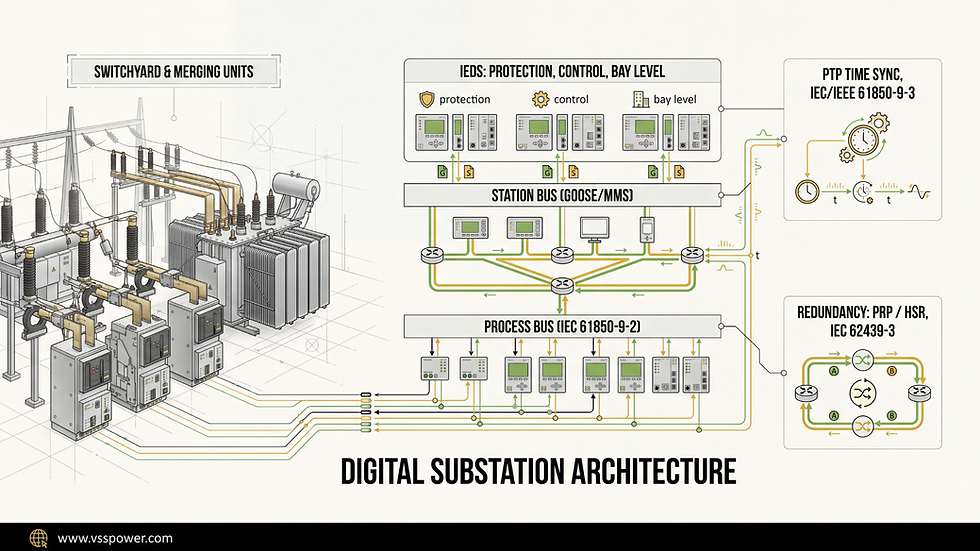
In today’s digital substation automation system, that definition covers three layers:
The station bus, carrying MMS reporting and GOOSE messaging
The process bus, carrying Sampled Values under IEC 61850-9-2
The network and time services that hold both together
The SCL File Family
SSD: the system specification, covering single-line structure and required functions
ICD / IID: the capability of one IED type or instance, supplied by the vendor
SCD: the complete system configuration, which should be the single source of truth
CID: the configured file loaded into an individual IED
Top-Down or Bottom-Up?
Most projects still work bottom-up: collect vendor ICD files, import them into a tool, then map signals by hand. This is manageable for one bay and expensive across a fleet of substations.
The top-down alternative starts with an SSD and reusable function templates, so data flows are defined before devices are selected. A Cigré B5.68 user survey explored what blocks this approach, and the group found no good examples of automated digital substation documentation. To close the gap, IEC working group WG10 developed IEC 61850-90-30 (function modelling in SCL) and IEC 61850-7-6 (basic application profiles). These let users create machine-readable function templates and test the system through simulation from the early specification stage.
If a fully top-down workflow is not realistic yet, adopt a hybrid: standard templates, a fixed naming convention and one owner for the SCD file.
Five Decisions for a Successful IEC 61850 Implementation
A successful IEC 61850 implementation depends on decisions made before detailed design starts. Each one is expensive to reverse later.
Edition and profile. Specify Edition 2 or 2.1 and verify each IED's declared conformance in its ICD file. Mixed editions are a common source of SCL and GOOSE problems.
Process bus scope. Work out the bus system scope and decide whether to use a station-bus-only arrangement or one based on full IEC 61850-9-2 with merging units and IEC 61869-9 digital instrument transformer interfaces.
Redundancy. Redundancy: IEC 62439-3 specifies PRP (for parallel networks) and HSR (for rings); PRP is easier to reason about, whereas HSR can reduce the number of switches.
Time synchronisation. Time synchronisation is required, and sampled values must have accurate, dependable timing. Plan PTP using the IEC/IEEE 61850-9-3 power utility profile, with redundant grandmasters and holdover.
Cybersecurity. Cybersecurity—apply the principles of IEC 62351 and IEC 62443 from the start, namely network zoning, role-based access, and controlled engineering-laptop procedures.
IEC 61850 Protection and Control Engineering: Where Detail Matters
IEC 61850 protection and control engineering is based on messages instead of copper, and each message needs to have an owner. Simple rules of thumb that save commissioning time:
Fix a signal naming convention early and apply it to datasets, GOOSE control blocks and drawings.
Make the GOOSE datasets as small as possible and only subscribe to signals that a function actually needs.
The behaviour to be adopted in the event of a loss of GOOSE or sampled values should be set as block, fall back or alarm.
In order to carry out maintenance without causing an outage, use the test and simulation modes to isolate a bay.
Record each interlocking and breaker-failure dependency as a message flow, not merely as a logic diagram.
Physical layout matters too. High Voltage Substation design must allocate early space for merging unit cabinets, fiber routes and network panels near the primary plant. Retrofitting them into a finished layout is where schedules slip.
Lessons from UK Digital Substation Projects
UK networks have already tested this at scale. National Grid's AS3 project ran four piggy-back trials with different suppliers to prove IEC 61850-9-2 process bus concepts, while SP Energy Networks' FITNESS project implemented a real digital substation using mixed HSR and PRP redundancy. FITNESS delivered the UK's first live digital substation automation system at Wishaw 275 kV, and SP Energy Networks expected a footprint reduction of around 15 per cent as digital technology became the norm.
The lesson for digital substation engineering teams is that process bus technology works when engineering, network design and testing are treated as one discipline rather than three hand-offs.
Hardwired vs IEC 61850 Digital Schemes
Aspect | Hardwired scheme | IEC 61850 digital scheme |
Signal exchange | One copper pair per signal | GOOSE / Sampled Values over Ethernet |
Engineering record | Schematics, cable schedules | SCD file plus drawings |
Change management | Rewiring and re-termination | Reconfigure and retest |
Testing | Point-to-point checks | Network, message and logic tests |
Main risk | Wiring error | Configuration and cyber risk |
Digital Substation Engineering Checklist
Store the SCD file in source control and have an owner for the file.
Check each IED's edition and compliance.
Confirm the naming conventions prior to setup of any IEDs.
Review redundancy and time-synchronisation designs against potential failure scenarios.
Cybersecurity zones, accounts and patch process defined
Test and simulation procedures written before the factory test
Fibre routes and cabinet space reserved in the layout
Testing and Commissioning
Before downloading any CID, validate the SCD file using the schema and the semantic rules. Where possible, carry out the factory acceptance test with real IEDs and use simulators if this is not possible; then capture the network traffic to verify the message rates and VLAN behaviour. Check the device conformance evidence against IEC 61850-10. Lastly, intentionally introduce faults by removing a link, causing a switch to fail, or losing the grandmaster clock. The protection scheme should behave in a manner that was designed.

Conclusion
Skilled IEC 61850 engineering is not so much a matter of any one device as it is of a well-disciplined and repeatable process—this involving clear specifications, consistent data, tested networks and thoroughly documented behaviour. Utilities and developers in the UK, Europe, the Middle East and India who invest in the engineering workflow notice the advantages in the form of smoother commissioning and easier extensions.
If you are planning a new substation or a digital retrofit, VSS Power can support you with IEC 61850 engineering services for UK and international projects, from specification and SCL configuration to testing. Contact the VSS Power team to discuss your project.
Key Takeaways
IEC 61850 engineering is a layered process based on SCL files, and the SCD file should be the sole source of truth.
Template-based Top-down engineering minimises rework compared to doing device mapping one device at a time.
Decide edition, process bus scope, redundancy, time sync and cybersecurity before detailed design.
Define behaviour on loss of GOOSE or Sampled Values, and test it deliberately.
UK projects such as FITNESS and AS3 show that process bus works when engineering and testing are integrated.
FAQs
1. What is IEC 61850 engineering?
It is the process of describing a substation's functions, devices, data and communications in SCL files, then configuring IEDs from that description.
2. What is the difference between ICD, SCD and CID files?
An ICD describes one IED's capabilities, the SCD describes the whole system, and a CID is the configuration loaded into a single IED.
3. Why choose a digital substation over a conventional one?
Fibre communication replaces much of the copper wiring, which can reduce footprint and wiring effort and improve diagnostics. SP Energy Networks expected a footprint reduction of around 15% in its FITNESS project.
4. Should I use PRP or HSR for redundancy?
Both are defined in IEC 62439-3. PRP uses two parallel networks, while HSR uses rings and can reduce switch count. The right choice depends on topology, cost and operator preference.
5. How is an IEC 61850 system tested?
Through SCD validation, factory acceptance testing, traffic analysis and fault-injection tests such as link, switch and clock failures.


Comments