Grid-Forming Inverters UK: The Future of BESS Stability


A Grid Running Out of Spinning Mass
Britain's electricity system is losing something it has relied on for a century: physical inertia. Every coal and gas turbine that closes takes with it tonnes of spinning steel that once absorbed shocks automatically, whenever a fault or a sudden loss of generation hit the network. Wind and solar farms, and battery storage connected through conventional inverters, don't replace that inertia on their own. This is the operability problem that has pushed grid-forming inverter deployment in the UK from a niche pilot to a mainstream design requirement in barely five years.
For utilities, developers, EPC contractors and transmission operators now specifying battery energy storage systems (BESS), understanding grid-forming technology in the UK requirements isn't optional anymore. It determines whether a project can bid into stability contracts, whether it clears connection studies at a weak point on the network, and how the surrounding substation needs to be designed.
Grid-Forming vs Grid-Following: What's Actually Different
The vast majority of inverters that have been installed in the last twenty years are of the grid-following type. They function as a current source by measuring the voltage waveform that is already present on the grid and then feeding power in accordance with it. This approach works satisfactorily on a robust and rigid network, but fails or causes the inverter to disconnect when there is a weak or missing local voltage reference—a situation which is precisely what occurs as synchronous power plants are withdrawn.
An inverter capable of grid-forming acts more similarly to a voltage source since it sets its own internal voltage phasor and magnitude, just as a synchronous generator does, and then allows current to flow based on the difference between that internal reference and the rest of the network. In practice, it is able to energise a previously de-energised section of the network (effectuating a black start), to endure faults without losing synchronisation, and to provide synthetic inertia and fast fault current which help to stabilise both frequency and voltage in the first moments after a disturbance, long before any conventional frequency response mechanisms come into play.
Attribute | Grid-Following Inverter | Grid-Forming Inverter |
Operating principle | Current source, tracks grid voltage | Voltage source, sets its own reference |
Performance on weak grids | Degrades, may trip | Stable, supports weak short-circuit levels |
Black start capability | No | Yes |
Inertia contribution | None (or slow synthetic response) | Near-instantaneous synthetic inertia |
Fault ride-through | Reference-dependent | Inherent to control design |
Typical use case today | Standard grid-tied BESS/PV | Stability-contracted BESS, weak-grid connections |
How Grid-Forming Inverters Work in BESS
To understand how grid-forming inverters work in BESS, focus on the control architecture, not the battery chemistry. A grid-forming BESS combines a traditional lithium-ion (or, increasingly, LFP) battery bank with power-conversion firmware that implements a voltage-source control loop, typically a virtual synchronous machine (VSM) or a droop-based algorithm. The converter continuously produces an internal equivalent rotor angle, allowing it to interact with frequency deviations in a way that mimics a turbine-generator's spinning mass, trading real power on a millisecond timescale rather than the seconds-based timescale of conventional frequency response.
The battery itself needs headroom to support this: most grid-forming specifications require de-loaded operation or reserved capacity so the converter can supply an instantaneous power surge on demand, rather than running flat-out on an energy-arbitrage schedule. This is a real commercial trade-off developers need to model early, because it affects how much of the asset's capacity is available for wholesale trading versus reserved for stability duty.

The UK Policy and Standards Picture
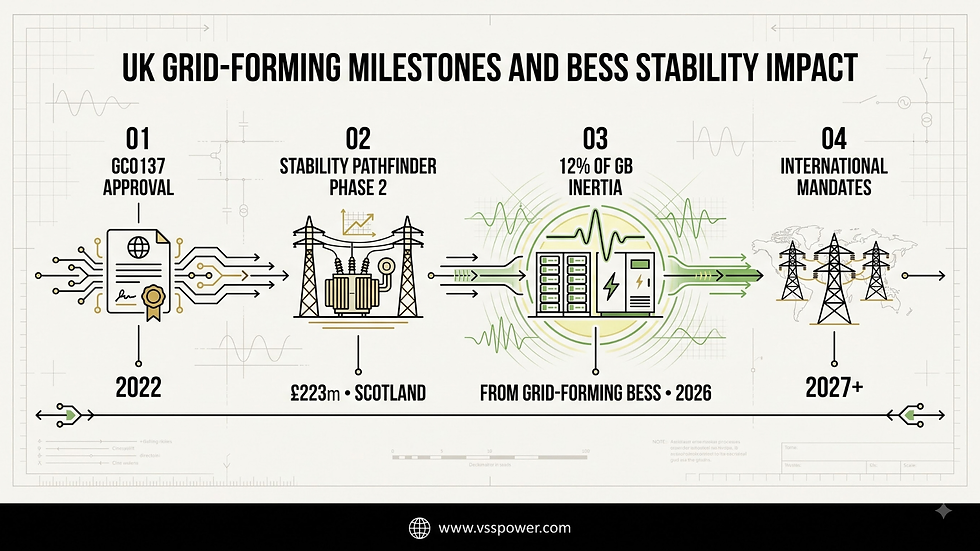
Great Britain was the first system operator in the world to define a formal grid-forming specification inside its Grid Code. The role of grid-forming inverters in UK BESS stability is now codified through NESO's GC0137, "Minimum Specification Required for Provision of GB Grid Forming (GBGF) Capability," approved by Ofgem in January 2022 and built around a non-mandatory technical specification that lets asynchronous plant, including batteries, exhibit fault-condition characteristics similar to conventional synchronous machines. NESO backed this with a GB Grid Forming Best Practice Guide and accompanying guidance notes for developers.
Commercially, the mechanism that rewards the capability is Stability Pathfinder. Under the programme's second phase, National Grid ESO awarded ten contracts worth £223 million to stability projects in Scotland, split between synchronous condensers and grid-forming BESS, securing 11.55 GVA of short-circuit level and 6.75 GVA-seconds of inertia. Grid-forming battery storage is projected to supply roughly 12% of Great Britain's contracted inertia by 2026, and NESO's Markets Roadmap has since moved procurement toward fully commercialised day-ahead and year-ahead stability markets rather than one-off pathfinder tenders.
The direction of travel is the same around the world. ENTSO-E is preparing technical requirements for a pan-European grid-forming application for power park modules, Finland has already regarded grid-forming capability as a necessity in certain cases involving BESS connections, and Germany's TSOs have launched rounds for the procurement of inertia. For UK-based EPCs who are exporting their expertise to Europe or the Middle East, compliance with IEC 62477, the IEC 61400-21 test methodology, IEEE 2800, and the appropriate BS EN harmonised standards together with GC0137 is now becoming a real requirement for export, not merely a matter of good practice.
Substation and Connection Implications
The ability of the battery to form a grid doesn't mean that the design of the surrounding high voltage substation is unaffected; instead it affects the way the substation design has to be approached.
Because fast fault current injection is involved, the protection coordination studies have to be altered since the traditional overcurrent relays are set up with synchronous fault characteristics in mind. The reactive power and voltage control methods have to be redefined at the point of connection, the fault ratings for the transformer and switchgear must take into account the inverter's actual current contribution profile rather than making use of a general converter assumption, and the control system integration between the BESS controller and the substation SCADA has to be capable of dealing with sub-cycle response times that the older RTUs were not designed to handle. It is necessary to consult the DNO or NESO at an early stage, together with carrying out G99 or full Grid Code compliance studies, in order to prevent having to carry out an expensive redesign after the grid-forming performance requirements have been confirmed.
A Practical Checklist for Developers and EPCs
Verify if short-circuit capacity at the connection point supports grid-forming or grid-following investments
Model de-loading and reserved headroom against the revenue-stacking assumptions early on in feasibility
State converter compliance to GC0137 and applicable IEC/IEEE standards in the OEM contract, not post-FEED
Align protection and HV substation design studies with the inverter's actual fault current signature
Factor in compliance testing and NESO's governance process, which will take more time than a standard grid-following connection.
Where This Leaves UK BESS Projects
Grid-forming is no longer a differentiator reserved for flagship pathfinder projects; it's becoming baseline due diligence for any transmission-connected battery scheme in a system losing synchronous inertia year on year. Projects that specify the capability, and the substation design to match, position themselves for both today's stability contracts and the mandatory requirements that other markets are already signalling for 2027 and beyond.
VSS Power works with utilities, developers, and EPC contractors across the UK and beyond on high-voltage substation design and grid connection engineering for battery storage and renewable projects. If you're planning a BESS scheme and want it engineered to meet grid-forming and Grid Code requirements from the outset, contact our team.
Key Takeaways
Declining synchronous generation is driving NESO to treat grid-forming capability as core to UK grid stability, not an optional add-on.
GC0137 made Great Britain the first system operator worldwide with a formal Grid Code specification for grid-forming capability.
The BESS that is grid-forming makes money by taking part in the Stability Pathfinder and in the subsequent markets, but this requires it to have reserved converter capacity which in turn affects its trading capacity.
The way in which grid-forming performance operates alters the way in which protection systems are coordinated, the ratings of the switchgear, and the integration of control systems in the design of high-voltage substations.
It is becoming more and more necessary for projects with international ambitions to comply with the GC0137 standard as well as the IEC, IEEE and BS EN standards.
FAQs
1. What is a grid-forming inverter in a UK BESS project?
It's a power conversion system that creates its own internal voltage reference, similar to a synchronous generator, rather than simply tracking the grid's existing voltage. This lets a battery storage system support weak networks, ride through faults, and potentially black start.
2. Is grid-forming capability mandatory under the GB Grid Code?
Not yet; although GC0137 introduced a non-mandatory minimum specification, it forms the basis of the Stability Pathfinder contracts and is widely anticipated to become the default requirement for new transmission-connected BESS.
3. How does grid-forming technology affect BESS revenue?
Grid-forming BESS systems are able to obtain stability payments that are not available to grid-following systems, but typically have to leave capacity unused rather than operating at full output, which in turn affects their income from arbitrage and from the balancing mechanism.
4. What standards apply to grid-forming inverters besides the GB Grid Code?
These include IEC 62477, IEC 61400-21 testing standards, IEEE 2800, and emerging ENTSO-E and BS EN harmonised standards, especially when the project spans UK and European markets.
5. Does grid-forming capability change substation design requirements?
Yes. Coordination of protection, fault rating of switchgear, reactive power control scheme, and SCADA integration all have to be reviewed based on the fault current of the inverter.


Comments